
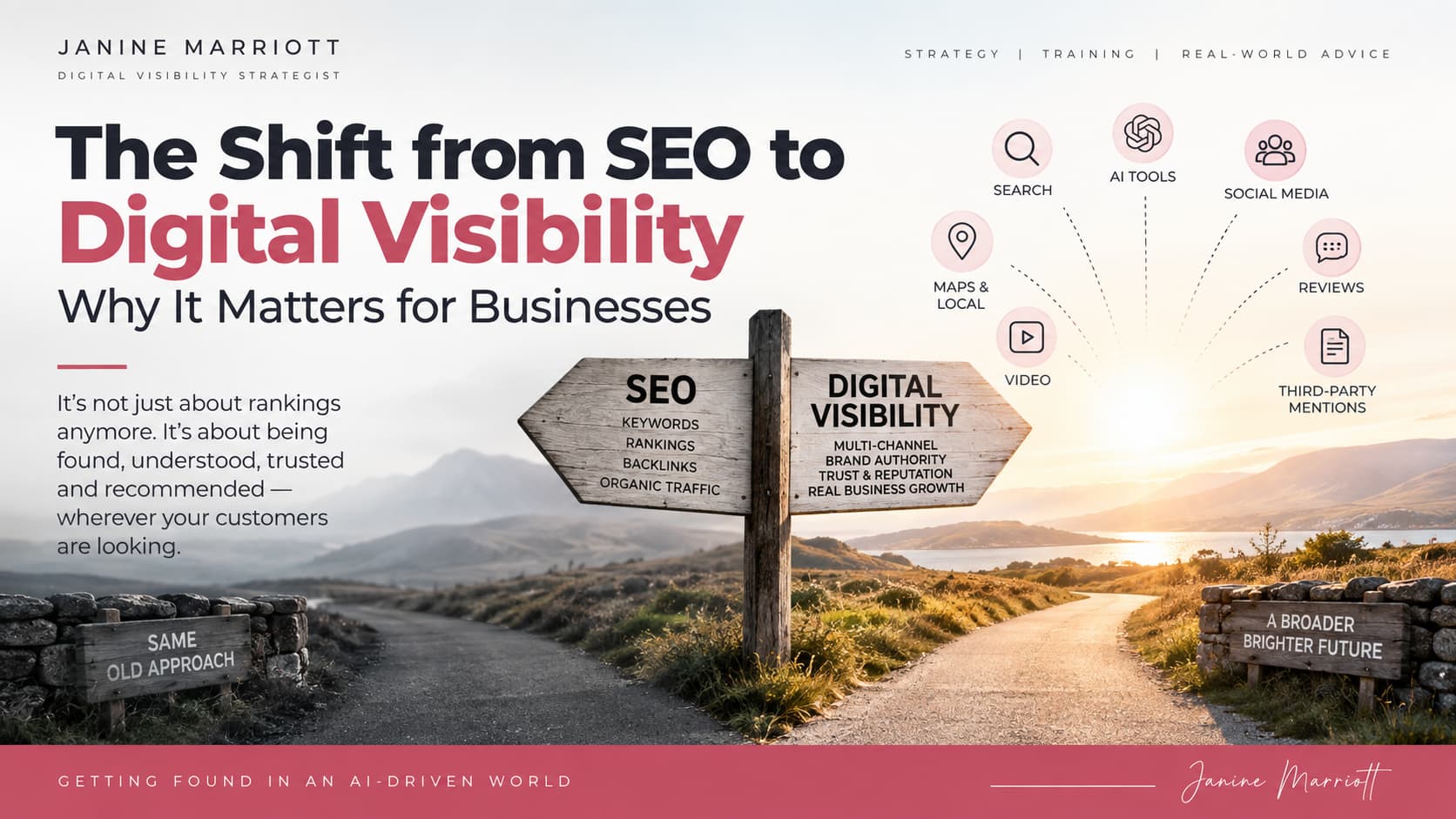
SEO still matters, but the way people discover, research and choose businesses has changed. Digital visibility is the wider strategy: being discovered, understood, trusted and recommended wherever your customers are looking, not just ranking well in Google. I created the Digital Visibility Method™ to help businesses make that shift in a practical way.
 From Traditional SEO to Digital Visibility
For years, businesses have been told that getting found online means doing SEO.
Rank for the right keywords. Get onto page one of Google. Build links. Produce content. Watch your organic traffic increase.
None of that has suddenly stopped mattering.
But the way people discover businesses has changed so significantly that I don’t think rankings alone give us a complete enough picture anymore.
Customers don’t only search Google, click a blue link and make a decision.
They might see a business mentioned on LinkedIn. Ask ChatGPT for recommendations. Check Google reviews. Search Reddit to see what real customers think. Watch a video. Go back to Google. Visit the company’s website. Compare three competitors. Ask an AI assistant a follow-up question.
And they may do all of that before you ever see them appear in your analytics.
That is why I believe businesses need to make a shift in thinking:
From SEO as the goal to digital visibility as the goal.
SEO remains incredibly important. But it is one part of a much bigger picture.
I created the Digital Visibility Method™ to help businesses understand that bigger picture and build visibility around how customers actually discover, research and choose businesses today.
Traditional SEO made sense for the environment it developed in.
People went to a search engine, typed a relatively short query and received a page of results.
For businesses, the objective was fairly clear: appear as high as possible on that page.
That led to a huge focus on things such as keywords, backlinks, rankings and organic traffic.
And those things still have value.
The problem comes when we continue measuring online visibility as though the customer journey hasn’t changed.
It has.
People now move between search engines, AI tools, social platforms, video, maps, review websites, online communities and other sources as they research. That broader discovery behaviour is exactly why the shift described in your outline matters.
The question therefore becomes much bigger than:
“Where do we rank?”
It becomes:
“Where can our customers find us, and what will they discover when they do?”
That is the shift from SEO thinking to digital visibility thinking.
SEO Is a Tactic. Digital Visibility Is the Wider Strategy
I don’t see digital visibility as a replacement for SEO.
Quite the opposite.
Good SEO helps create digital visibility.
A technically sound website matters. Search engines still need to crawl, understand and index your content. Keyword research can still reveal customer demand. Internal linking, site structure, content, structured data and backlinks still have important roles to play.
But SEO sits within the wider strategy.
For me, digital visibility is your ability to be discovered, understood, trusted and recommended wherever your customers are looking.
That can involve your website and organic search, but also:
- local and map visibility;
- reviews and reputation;
- social and professional platforms;
- product feeds and shopping platforms;
- video;
- third-party publications and mentions;
- forums and online communities;
- AI-generated answers and recommendations.
That broader mix is consistent with the outline’s framing of digital visibility as an overarching strategy rather than search optimisation alone.
And not every business needs to be everywhere.
The important question is whether you are visible in the places that matter to your customers.
Search Has Changed from Matching Words to Understanding Needs
One of the most significant changes is the way people can now express what they are looking for.
Traditional search often encouraged us to compress a need into a keyword.
A person who really meant:
“I need a recruitment agency that can supply reliable temporary warehouse staff at short notice and understands the challenges of filling night shifts”
might have searched:
warehouse recruitment agency Glasgow
AI removes much of that constraint.
People can explain the entire situation.
They can add requirements.
They can specify what they don’t want.
They can ask follow-up questions.
They can compare options.
They can ask for recommendations based on very specific circumstances.
That means businesses need to think beyond simply being relevant to a keyword.
You need to provide enough information for people — and increasingly the systems helping those people — to understand when you are the right choice.
This is why I spend so much time looking at customer questions, situations and constraints, not just search volume.
The keyword tells us part of the story.
The reason behind the search often tells us much more.
Why This Shift Matters to Businesses
If you continue judging success largely by Google rankings, you risk missing what is happening around them.
Imagine that your rankings remain relatively stable but fewer customers are clicking through from search.
That doesn’t automatically mean your SEO has failed.
It could mean that more of the customer’s question is being answered within the search experience.
It could mean customers are discovering brands somewhere else first.
It could mean the journey has become more fragmented.
Or it could mean competitors are appearing in places you haven’t considered.
This is why rankings need context.
A business can have good rankings and still have weak digital visibility.
Equally, a business may be building considerable visibility and demand that cannot be neatly attributed to one organic click.
The danger is using an old measurement framework to judge a new customer journey.
That is also why the outline rightly moves beyond rankings and traffic toward business outcomes such as enquiries, brand awareness and growth.
Being Found Earlier Matters
Another advantage of thinking about digital visibility is that it encourages us to consider the whole buying journey.
SEO strategies have sometimes concentrated heavily on people who are already quite close to knowing what they need.
But customers often begin much earlier.
They may start by describing a problem.
They may not know the name of the product or service that solves it.
They might be comparing approaches rather than suppliers.
They might simply be trying to understand what their options are.
This creates opportunities for businesses to become visible before someone reaches the obvious commercial search.
If you consistently help people understand the problem, evaluate their choices and make a decision, you have a much greater opportunity to become part of the consideration set.
That matters whether the eventual discovery happens through Google, ChatGPT, Reddit, LinkedIn, YouTube or somewhere else.
Digital Visibility Can Help Smaller Businesses Compete
There is also an important opportunity here for smaller organisations.
You aren’t necessarily going to beat a much larger competitor simply by producing more content than they do.
You may not have their budget, brand recognition or backlink profile.
But you can often be more specific, more useful and more knowledgeable about your customer.
You can explain niche situations larger competitors overlook.
You can answer very specific questions.
You can demonstrate first-hand expertise.
You can create genuinely useful resources.
You can show evidence of the work you do.
You can earn recommendations in the places where your particular audience spends time.
And you can become exceptionally clear about who you are right for.
AI-driven discovery actually makes that specificity very interesting.
If somebody asks a broad question, the biggest brand may have an advantage.
But the more constraints somebody adds, the more important genuine relevance becomes.
The opportunity isn’t necessarily to become the most visible business on the internet.
It’s to become one of the most relevant businesses for the people you genuinely want to attract.
Your Brand’s Wider Digital Footprint Matters
This is where businesses also need to look beyond what they say about themselves.
Your website is important because it is the place where you control the information.
But other sources contribute to how people perceive you.
Reviews.
Customer discussions.
Industry websites.
Directories.
Professional profiles.
Podcasts.
Media coverage.
Social conversations.
Expert contributions.
Independent recommendations.
All of these create context.
I often describe it as:
Everything pulls from somewhere.
If someone hears your name on a podcast, then Googles you, reads your reviews and visits your website, those aren’t four unrelated marketing activities.
They are part of one journey.
Digital visibility asks us to consider how those pieces work together.
Digital Visibility Also Changes What We Measure
If the customer journey is becoming broader, our measurement needs to become broader too.
Keyword rankings and organic traffic remain useful.
I certainly wouldn’t stop measuring them.
But they shouldn’t exist in isolation.
Depending on the business, I would also look at things such as:
Brand demand. Are more people searching specifically for your business or products?
Non-branded discoverability. Are you appearing around the problems and questions customers have before they know your name?
Traffic sources. Are people discovering you through a broader mix of sources?
AI visibility. Are you being cited, mentioned or recommended for relevant questions?
Third-party visibility. Where is the business being discussed or referenced beyond its own website?
Conversions. Are the people discovering you actually becoming enquiries, customers or sales?
Authority and trust signals. Are reviews, mentions, case studies and other evidence growing?
This also reflects the outline’s recommendation to move beyond vanity metrics and look at brand search growth, multi-channel engagement, conversions and share of voice.
This is also why I am cautious about trying to reduce digital visibility to one neat score.
A number may look appealing on a dashboard, but it can hide the more important question:
Are more of the right people discovering the business and becoming confident enough to choose it?
How Businesses Should Adapt Their Strategy
The answer is not to panic and create accounts on every new platform.
Nor is it to abandon SEO and start trying to “optimise for AI” instead.
Start with the customer.
Where do they look?
What do they ask?
What concerns do they have?
What information do they need before making a decision?
Who or what influences them?
What evidence gives them confidence?
Then look at your current visibility against that journey.
Your website should still be technically strong and easy to understand.
Your important products or services should contain enough information to answer genuine customer needs.
Your business information should be clear and consistent.
Your expertise should be visible.
Your reviews and reputation should support the claims you make.
And you should have a meaningful presence in the channels that genuinely influence your audience.
That is much more sustainable than chasing every platform or algorithm change.
Content Still Matters – But Its Job Is Bigger
Content remains one of the most important parts of this.
But I think we need to stop thinking of content as something we create simply because a keyword has search volume.
Good content can perform several jobs.
It can help someone discover you.
It can explain something clearly.
It can demonstrate experience.
It can answer a question.
It can remove uncertainty.
It can give another website something useful to reference.
It can provide information an AI system may use when understanding your expertise.
It can help an existing prospect decide whether to trust you.
Sometimes it can do several of those things at once.
That is a much stronger reason to create something than simply:
“Keyword X gets 500 searches per month.”
The role of content as a driver of authority and visibility across multiple formats is also a central point in the outline.
What Happens Next?
Search will continue changing.
AI will become more embedded in how people research.
Voice and visual discovery will continue developing.
Platforms we haven’t considered yet will inevitably emerge.
I don’t think businesses can — or should — try to predict every change.
What we can do is build a strong foundation.
Be discoverable.
Be clear.
Demonstrate expertise.
Build authority outside your own website.
Earn trust.
Understand your customers properly.
And make it easy for both people and technology to recognise when your business is relevant.
That is why I believe the move from SEO to digital visibility matters.
It isn’t about abandoning everything we know about search.
It is about recognising that search is now one part of a much wider discovery journey.
SEO remains essential.
But the goal has become bigger.
The goal is visibility wherever the right customer is making their decision.
AI transparency: This article was created with AI assistance using my own ideas, experience, research and conversations. I have reviewed and edited the final content, and the views expressed reflect my own professional approach and the principles I teach through the Digital Visibility Method™.